
By Mike Romero
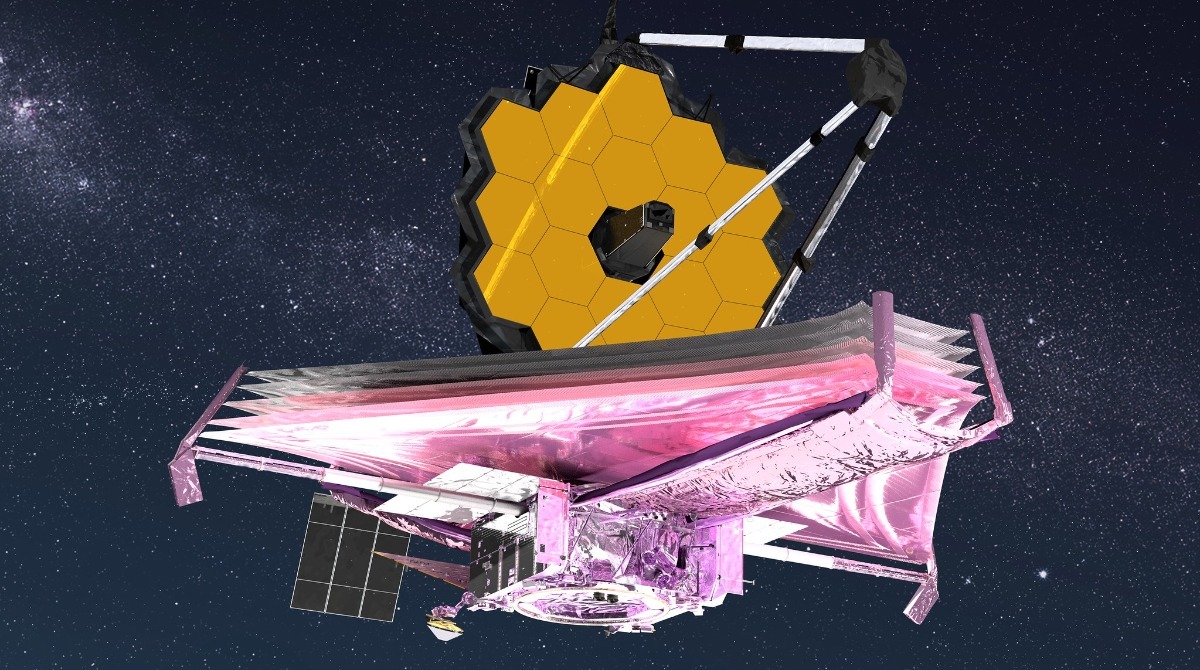
In a remarkable achievement, Utah Valley University science professor Joshua Lothringer helped an international team of planetary researchers discover carbon dioxide (CO2) on an exoplanet. It’s located an astonishing 700 light-years away from Earth. Employing NASA’s state-of-the-art James Webb Space Telescope (JWST), this revelation has potential compelling ramifications for our understanding of distant planetary systems.

How did they pull this off? Through meticulous observation orchestrated by Lothringer and his fellow scientists. By intently focusing the JWST on a remote star and closely tracking its luminosity over time, a dimming pattern emerged. This phenomenon was the telltale sign of an exoplanet, known as Hot Jupiter WASP-39b, casting a shadow as it passed between the star and the telescope.
The light emitted by stars near the exoplanets that orbit them presents a formidable challenge to direct observation. But infrared cameras, similar to the tech behind night vision technology, track variations in the infrared spectrum emanating from these faraway worlds.
Lothringer’s job was to determine if carbon dioxide was present on the planet. Gases absorb light in distinct fashions, manifesting in discernable color combinations. Carbon dioxide, in particular, absorbs a specific wavelength of red infrared light, a phenomenon that escapes the naked eye. Infrared cameras decode this crucial information.

Lothringer used sophisticated computer programs and algorithms to document the light spectrum. “It took months to assemble and sort the data,” said Lothringer about finding CO2. “It is a painstaking process because the wavelengths of the light are measured between 3 and 5.5 microns, and the data has to be exact. However, when all was said and done, it was thrilling to know that we have this ability and that we are contributing to a science that will hopefully someday lead us to habitable planets.”
Hot Jupiter WAS-39b lives up to its name. Made up of hot gas, its temperature is approximately 1,600 degrees Fahrenheit or 900 degrees Celsius. Lothringer’s research has already been published on NASA’s Early Release Science program website: “NASA’s Webb Detects Carbon Dioxide in Exoplanet Atmosphere,” and in Nature: “Identification of carbon dioxide in an exoplanet atmosphere,” a weekly international journal that publishes peer-reviewed research in all fields of science and technology.
WAS stands for “Wide Angle Search for Planets.” Scientists use number and letter designations coupled with the WASP descriptions to keep track of the exoplanets.
Lothringer worked with more than 100 other scientists, who, in addition to CO2, found water vapor, sodium, and potassium in the atmosphere. These findings establish a foundation pivotal for the exploration of smaller, potentially habitable planets. This is especially relevant, given recent congressional discussions surrounding the possibilities of extraterrestrial life.
 Provo Tribune: Local News for the Provo/Orem Area