Categories
University News

BYU Engineers Collaborate with Toyota on Advanced Welding Technique

Advertisements

By Mike Romero

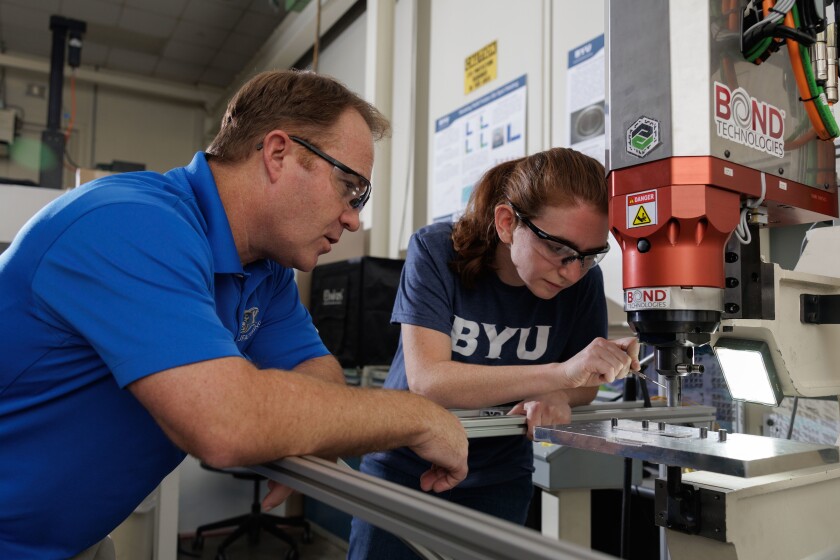
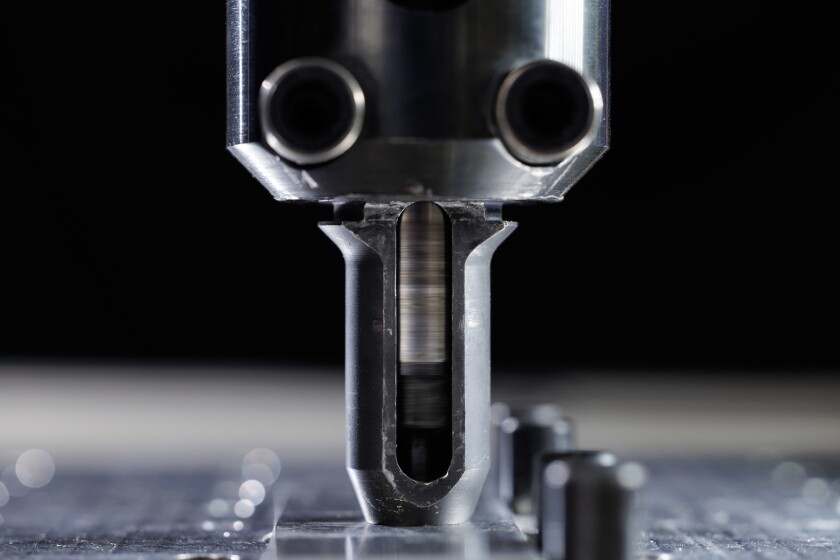
Brigham Young University engineers have partnered with Toyota to develop a new welding method aimed at improving automotive manufacturing. The technique, called refill friction stir spot welding, uses 40 times less energy, reduces emissions, and creates welds 10 times stronger than traditional methods.

Designed for aluminum body panels, the process helps address challenges in joining lightweight materials like those used in Toyota’s popular Sienna minivan. Unlike conventional welding, which melts metal, the new method joins aluminum without melting, resulting in stronger, more efficient bonds. The innovation also reduces the need for filler material, making the process more sustainable.

“Ultimately, we’re focused on doing things more efficiently, greener, and cleaner,” said BYU professor Yuri Hovanski, who led the project.

The collaboration began after Toyota saw a demonstration of the technology at a conference. BYU researchers and Toyota engineers tested the new process at Toyota’s Indiana plant, finding that the method could enhance the production of aluminum sliding doors, used in the Sienna and other vehicles.

BYU graduate student Damon Gale, who contributed to the research, said the method could become the new standard for joining aluminum body panels in the automotive industry.

The project aligns with Toyota’s commitment to clean technologies, Hovanski said, adding that the partnership reflects BYU’s mission to foster environmentally conscious engineering.

Learn more at engineering.byu.edu.

Refill friction stir spot welding joins the metal without ever melting it.
Advertisements
Categories
Provo City News

How Much Would It Cost To Pump Ocean Water Into The Great Salt Lake?

Advertisements

By Richard Provost

Turns out, pumping just one third of the water we need to save the Great Salt Lake would require 400 megawatts of electricity. For reference, that’s 11% of the energy the state of Utah uses in a single year.

In a new study from the Ira A. Fulton College of Engineering at Brigham Young University, BYU engineers have analyzed how much energy and money would be required to save the Great Salt Lake by transporting water in from the Pacific Ocean through a single large-diameter pipeline.

Advertisements

In addition to using 400 megawatts of electricity, it would also require $300 million dollars a year to operate (on top of the multibillion-dollar cost to build a pipeline) and would emit nearly one million metric tons of carbon dioxide (or 200,000 passenger vehicles) each year. BYU’s Todd Hollingshead reported that these are very conservative estimates. The pipeline would have to pump water 600 miles inland while gaining 4,200 feet of elevation.

BYU’s Rob Sowby. Photo courtesy of BYU Photo.

“The figures could easily triple with a longer pipeline route, mountainous terrain, higher flows, multiple pipelines or less efficient pumps,” said Rob Sowby, BYU professor of civil engineering and lead author on the analysis. “To put it mildly, there are serious challenges to this approach.”

Advertisements

TLDR: we’d save the Great Salt Lake but would worsen our inversion problem and incur serious financial costs.

Sowby worked on this analysis with BYU professors Gus Williams and Andrew South. “While the idea sounds extreme, so are the circumstances, some argue, and all options should be kept open,” Williams said. “That said, we’re not providing an opinion on the necessity or feasibility of such a project; our analysis is to inform Great Salt Lake stakeholders, decision makers and the public on what the costs could be.”

“After years of neglect, the Great Salt Lake is starving not just for water but for attention,” Sowby said. “Facing an environmental crisis, we are compelled to rethink our relationship with the Great Salt Lake, to treat it like the precious asset it is rather than as a casual afterthought.”

The road leading across the Great Salt Lake from Promontory Point. Photo by Urvish Oza.
Advertisements
Categories
University News

BYU Engineering Releases Spaceport America Documentary

Advertisements

By Mike Romero

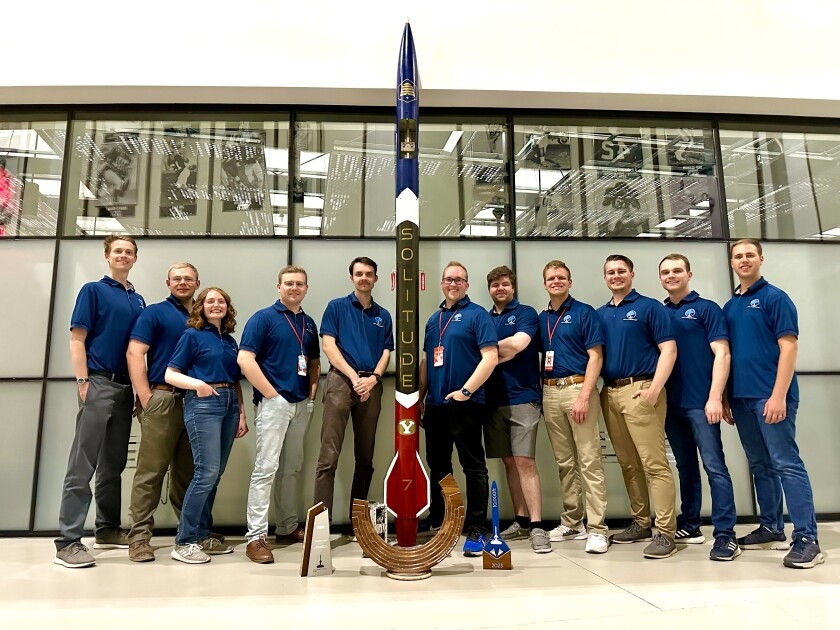
What does it take to compete in the world’s largest intercollegiate rocket engineering competition? A new documentary from the Ira A. Fulton College of Engineering answers that question. Shot by BYU students and filmmakers Sawyer Nunley and Heber Stanton, it tells the story of BYU’s High-Power Rocketry Team as their rocket, Maverick, prepares for launch at the 2022 Spaceport America Cup.

Advertisement.

Maverick was built with an Aerotech M2400 motor and a machine-learning module to prevent water from sloshing within the rocket’s payload. Despite mechanical difficulties ahead of launch, the rocket reached a height of 10,432 feet, earning the BYU team a rank of 11th out of 46 teams in their category at the 2022 Spaceport competition. The team also received 2nd place for the Barrowman Award for Flight Dynamics and 2nd place for the Sportsmanship Award.

The BYU rocketry team returned to take 1st place in the 2023 Spaceport America Cup with their rocket, Solitude (named for the Utah-based ski resort). They also received 1st place for Modeling and Simulation. BYU beat out 157 other collegiate teams from 24 countries for the title.

Check out the documentary below.

Advertisements
Categories
University News

BYU Students Construct Solar-Powered Concrete House on Campus

Advertisements

By Zach Collier

In a groundbreaking achievement, students from Brigham Young University (BYU) have designed, engineered, and built a sustainable, zero-energy dwelling directly on campus. Tucked away behind BYU’s Snell Building, this two-bedroom, two-bathroom residence has received hundreds of visitors this month.

Advertisements

Affectionately known as the “Triple Dome Home,” this architectural marvel comprises three interconnected monolithic concrete domes. A featured dwelling in the Utah Valley Parade of Homes, this zero-energy domicile spans a modest 850 square feet and stands as a testament to the prowess of student builders. This transportable house can be relocated wherever a crane can be stationed. In fact, this particular dwelling will soon be uprooted and transported to California for sale later in the fall.

Built as part of the U.S. Department of Energy’s Solar Decathlon, it’s meticulously designed. The house aims to minimize its carbon footprint, curtail water consumption, and effortlessly maintain a consistent temperature throughout both frigid winters and scorching summers.

The interior of the BYU Triple Dome Home by BYU Photo.

The Triple Dome Home boasts several remarkable engineering features, including the utilization of fiberglass in lieu of rebar as the primary material for reinforcing the concrete structure. Additionally, a PVC membrane envelops the entirety of the exterior walls, providing insulation and imperviousness to water. Portions of the exterior walls are concealed beneath soil, rocks, and plants, creating an innovative berming technique.

Advertisements

The residence harnesses the power of 34 double-sided solar panels seamlessly integrated into a carport and an adjacent pergola. Thanks to its concrete dome construction, the house boasts windproof and fireproof properties while remaining resilient to extreme temperatures. Enhanced energy efficiency is achieved through the inclusion of triple-paned windows.

This undertaking has stretched the physical and intellectual capabilities of over 20 students involved in the design, engineering, and construction processes.

BYU represents one of the 15 universities hailing from the United States, Canada, and India that took part in the esteemed Solar Decathlon Build Challenge. Later this year, the BYU team and their Triple Dome Home will also compete in the Orange County Sustainability Decathlon.

There are only two days left to tour the home before it moves to California. The Utah Valley Parade of Homes is happening now, and concludes on June 24.

Advertisements
Categories
University News

BYU Students Engineer The Most Fuel-Efficient Vehicle in North America

Advertisements

By Mike Romero

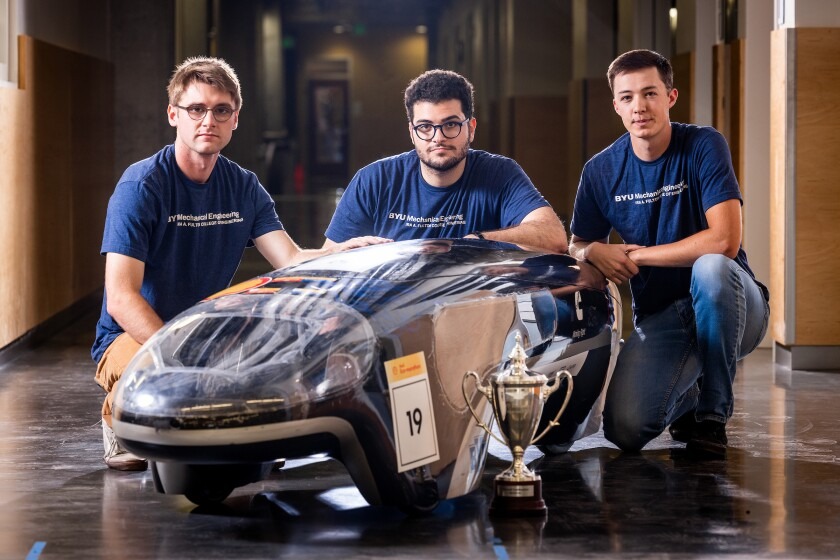
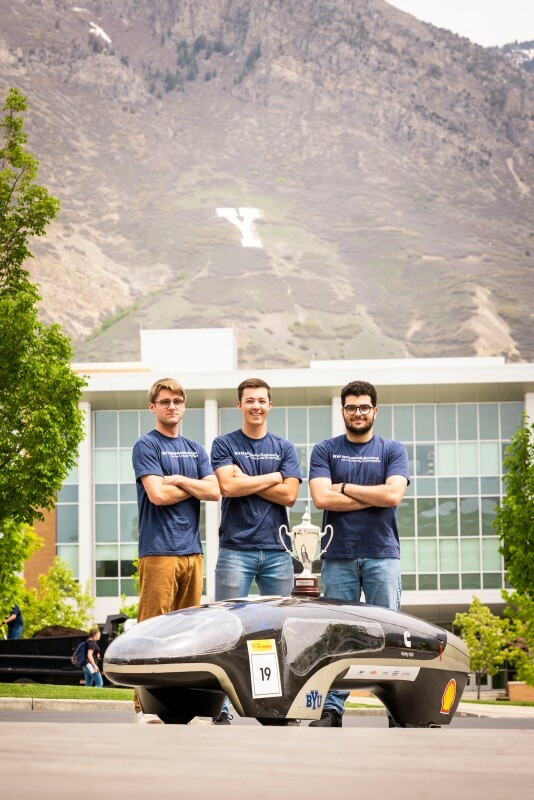
Engineering students at Brigham Young University (BYU) have achieved a remarkable feat by constructing the most fuel-efficient vehicle not only in the United States but also across the Americas. Their creation, known as a Supermileage vehicle, can travel an astounding distance of 1,915.83 miles per gallon. This remarkable achievement earned them the first-place title at the prestigious Shell Eco-marathon, an international competition that brings together teams from North and South America to develop the most fuel-efficient vehicles on the planet.

Advertisements

The Shell Eco-marathon took place at the Indianapolis Motor Speedway, a distance of 1,531 miles from Provo, where BYU is located. BYU’s car could have easily coasted to Indianapolis on less than a gallon of gas. Despite its remarkable fuel efficiency, the vehicle can only reach a maximum speed of 25 miles per hour. However, for the BYU Supermileage Team, speed is not the focus; their goal is to excel in long-distance efficiency.

Photo by Brooklynn Jarvis/BYU Photo
Advertisements

Throughout the competition, BYU’s car consistently outperformed other vehicles, surpassing the second-place car by over 100 miles per gallon. BYU had previously participated in the Eco-marathon but had not competed for four years due to the pandemic. Given their absence, the team’s expectations were modest. However, they devoted themselves wholeheartedly to the competition, demonstrating unwavering focus and determination.

Overall, the BYU Supermileage Team’s triumph at the Shell Eco-marathon showcased their remarkable engineering skills, teamwork, and problem-solving abilities. Their accomplishment not only earned them recognition as the best in the country but also solidified their position as the leading fuel-efficient vehicle builders on this side of the globe.