
By Charlie G. Patreus
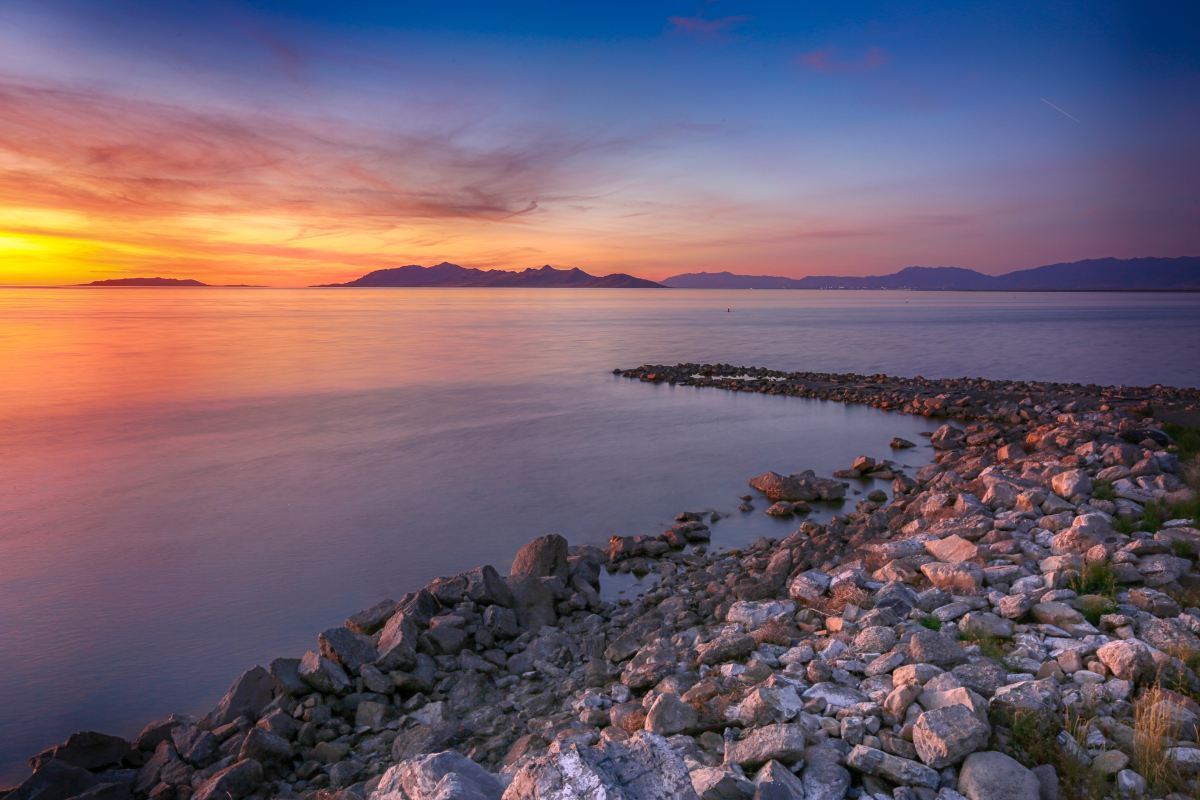
Much has been said about the issues facing Utah’s Great Salt Lake. The Great Salt Lake hit its lowest recorded water level ever in November 2022. Arsenic in the exposed lakebed threatens to poison the air. Scientists at Brigham Young University in Provo estimate that without policy changes, the lake will dry up in 2028, with local species killed off by overly salty water beforehand. Today’s exposed lakebed is currently strewn with the corpses of dead seagulls and swarms of brine flies.

Even after recovering five feet of new water from this year’s massive snow runoff, the Utah Division of Forestry Fire and State Lands reported it’s not going to be enough to fix the problem. The entire lake still needs to rise another five to six feet – hopefully more. In the 1910s, the iconic Black Rock was completely surrounded by water.
Will we ever refill the Great Salt Lake? One group doesn’t just think it’s possible – they think it’s not a big enough goal.

The ARCH-HIVE is a Utah-based art collective featuring “artists, musicians, writers, and thinkers exploring the unique perspectives & peculiarities of Utah, Mormonism, and the American West.” Art styles include folk, pop, esoteric, and psychedelic art. Known for their stylish design, tongue-in-cheek humor, and crowded art shows, the group frequently engages in quirky meet-ups. For instance: last October, the Mormon art group threw a Halloween gathering in Orem’s University Place Deseret Book – after it became a Spirit Halloween.
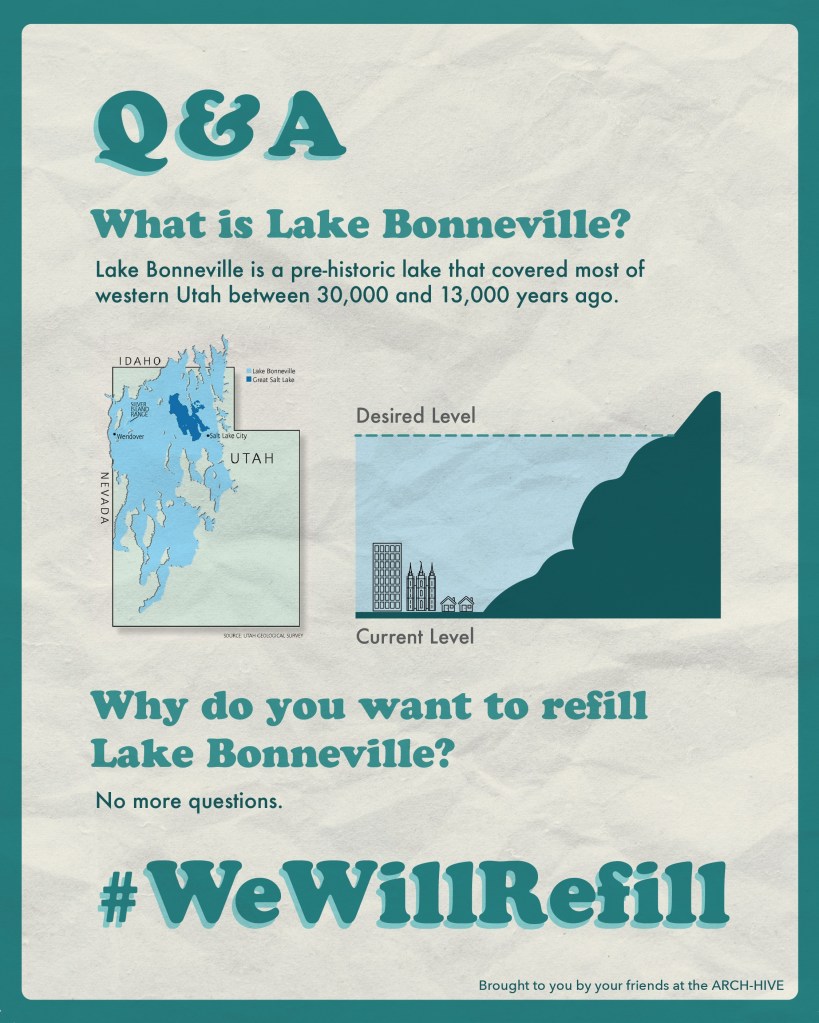
On August 12, 2023 they held a “Refill Lake Bonneville Protest” at the Black Rock Historic Site near the Great Salt Lake. The goal of the gathering was to not only save the lake, but to restore it to prehistoric levels. Lake Bonneville was a pluvial lake that covered most of the state during the Late Pleistocene, or Ice Age. The infographic below explains just how big these artists like to dream. And how much they value water over… pretty much all human life.
On the morning of the event, nearly two dozen attendees read poems, shouted protest chants, waved signs, and carried “Definitely Real and Definitely Not Cardboard Mitt Romney” to the shoreline before dumping “no more than 100 gallons” of water into the Great Salt Lake. According to the art collective, several attendees made a specific effort to ensure the water was sourced from outside the state of Utah. From what we observed, all water containers were recycled, and some participants removed existing trash and recyclables from the shore before heading home.
Hot dogs were consumed because the actual definitely-real-and-definitely-not-cardboard Mitt Romney’s “favorite meat is hot dog.” Many also gathered for frozen yogurt directly after the event.
Considering the fact that 2.5 billion gallons of water per day were flowing past the Willard Canal into the Great Salt Lake last May, “no more than 100 gallons” is statistically insignificant and will definitely not solve the environmental crisis. Despite this, The ARCH-HIVE insists that there is “definitely more water there than there was before” and “this is only the beginning.” Commenters on social media seemed to look forward to next year, when “dozens more gallons” would be added.
While certainly not the most effective means of delivering high volumes of water to our region’s iconic lake, if consistency turns this gathering into tradition, it could be a powerful and intriguing way to instill a love of environmental conservation in the hearts and minds of the average Utahn. Who knows?
At this point, we need all the help we can get.
Watch a recap of the gathering below.


 Provo Tribune: Local News for the Provo/Orem Area