
By Mike Romero
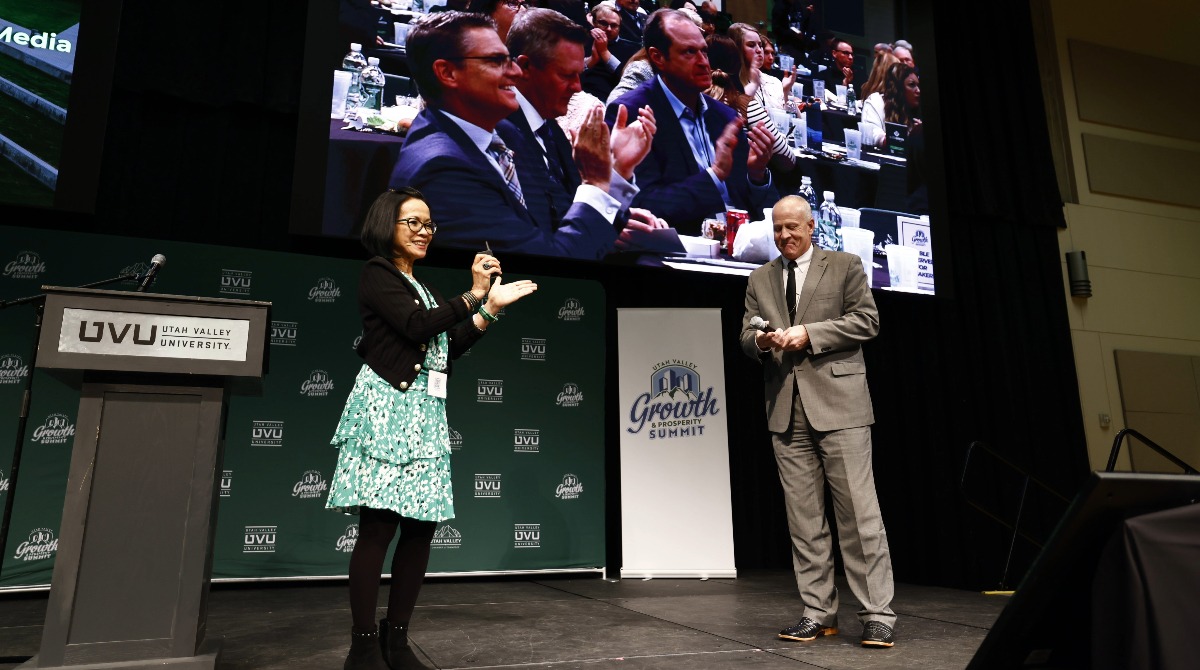
Last Thursday, nearly 500 people gathered at Utah Valley University for the 3rd annual Growth and Prosperity Conference. The conference aims to attract future-thinking people to address Utah’s rapidly increasing population and how it will impact transportation, education, air quality, infrastructure, workforce development, water, business, and economic development.

Hosted in partnership with the Utah Valley Chamber of Commerce, UVU welcomed speakers from key areas, including US Representative and former Provo Mayor John Curtis. Having served Provo for 8 years, Curtis understands the importance of managed growth and the impact it will have. “Thank you for planning the future of my valley for my kids and my grandkids. It is incredibly important work,” he said.
Curtis Blair, president and CEO of the Utah Valley Chamber of Commerce, stressed the importance of planning ahead. “We are dealing with unprecedented growth. It’s not going away. You can view it positively, you can view it negatively, you can view it neutral, but it’s coming,” Blair said. “So, how we manage that growth, the stewardship with which we manage that growth, will really dictate the quality of life for years to come – and I am talking generational impact.”
Laura Hanson, from the Governor’s Office of Planning and Budget, explained that between 2010 and 2020, Utah was the fastest growing state in the nation at 18.4 percent – far outpacing neighboring communities and states. Hanson revealed that historically optimistic Utahns are finally feeling uncertain about the future.
“Every seven years, they do a survey, and one answer has been consistent through that time period,” Hanson said. “‘Do you think growth will make Utah better or Utah worse?’ For the first time in the history of this survey question, in 2021, Utahns said, ‘We are not sure that growth is going to make Utah better.’ That is a big change since the last time that we asked it in 2014.”
Specifically, Utahns are feeling pressures around housing and resources. The surveys also showed that Utahns don’t want to stop growth. They just want to be more intentional about it.
“Education and workforce development is one of our key seven pillars of growth. You cannot have businesses thriving if you do not have a qualified workforce,” said Curtis Blair. “We want our children to stay here. We would love for them to work here, live here, play, and recreate here, and we want to keep our grandchildren close to us.”
Astrid S. Tuminez, President of UVU, stressed the importance of a college education. There’s a median income gap of $30,000 a year between someone who merely graduates from high school and those who receive a college degree.
Tuminez reported that UVU is playing a key role in creating a strong Utah workforce. 77% of UVU graduates stay in Utah and are fueling the economy ten years after graduation. At the conclusion of her keynote speech, Tuminez announced a formal agreement between UVU and Mountainland Technical College (MTECH). The agreement creates a pathway for MTECH graduates in HVAC, electrical, plumbing, and welding to earn an associate degree in business management at UVU – in half the time.
While gathering to discuss these issues at all could be considered a success, what truly matters is how the event’s conversations and data sharing translate to future progress.
“All have come together to say these conversations matter,” Blair said. “We can’t do it in silos. We have got to figure out a way to partner and collaborate and bring this message down to the grassroots, and that’s our blocks and neighborhoods, our City Council, our mayors.”
For more information about the efforts being made by the Utah Valley Chamber of Commerce to plan for statewide growth, click here.
 Provo Tribune: Local News for the Provo/Orem Area